

Kyiv, Ukraine
I was invited by the government of Ukraine to give a talk about national resilience on the 35th anniversary of their independence from Russia. That separation had been decided by a national referendum and finalized with an agreement between the two countries that lasted until Russia invaded Crimea and Eastern Ukraine in 2014. Eight years later, in late February, 2022, they launched a full scale invasion which included armored column barreling eastwards from the Russia-allied country of Belarus.
My talk was one of many to a large delegation of international dignitaries and diplomats under a tent by the gorgeous Santa Sofia Cathedral in Kyiv. Estonia was there, as well as Finland, Lithuania, Serbia, Romania and even England. Not only was the backdrop spectacular, but the proximity to the famous cathedral may have been a hedge against getting rocketed by the Russians. I’ve had skeptics tell me that Russia had to invade Ukraine because NATO was trying to lure the country into their ranks. In truth, Russia invaded Chechnya (twice), Transnistria, Georgia, Crimea, and Eastern Ukraine without NATO moving a muscle. The Baltic States understandably joined NATO to protect themselves from a repeat of Russia’s takeover of their territories in 1940, and Ukraine was obviously worried about the same thing.
After my talk and a chance to meet First Lady Olena Zelenska, I was asked by a local media network what I thought of Ukraine. I said that my own country, the United States, might save itself from fracture and collapse by studying how the Ukrainian people have come together during the dark days of this terrible war. One man said he had joined the military to fight despite an exemption for anyone with over two children. He was scared of telling his wife, though, but when he did, she replied, “Good. If you hadn’t joined, I would have.” A Kazakh who volunteered for the International Brigade had his elbow shot out by a large caliber round. The elbow was completely replaced my metal, but his arm hung limply. “It was interesting,” he said about fighting. “I wouldn’t trade it for anything.”
And then there was the family who was targeted by Russian artillery as they fled Eastern Ukraine in the family car. The young son lost his leg in the strike - he was in attendance with a prosthetic - and everyone else in the family was wounded, including his pregnant wife. When asked what he wished for most, the father said, “When it rains, I wish for my children to no longer be scared of the thunder.” After a moment, he added, “And for a free Ukraine.”
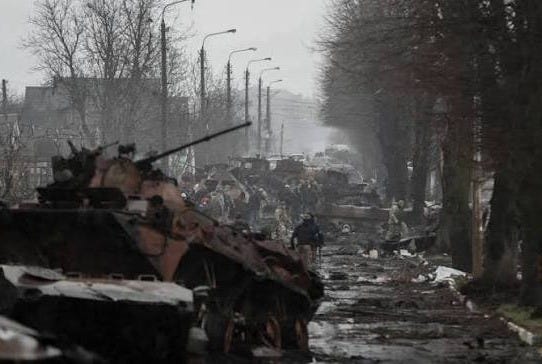
After watching the rise of nationalism in in the 1930s, the great - and forgotten - American journalist, John Whitaker, wrote: “Fascism is a system whose weakness lies in the fact that it can never show itself to be weak.” That fatal flaw was on full display during the Russian invasion of 2022. A Russian armored column fifty miles long got bogged down in mud and shot to pieces by Ukrainian citizens carrying rudimentary weapons. Told that Ukrainians would greet them as liberators, Russian troops were shocked to come under fire and quickly panicked. In the town of Bucha, they came across a war memorial of the Russian invasion of Afghanistan four decades earlier. The memorial featured an old armored personnel carrier, and even though it sat on a display pedestal, the Russians mistook it for a Ukrainian tank and attacked it. In nearby Irpin, an entire column of Russian armor was caught in a bottleneck and destroyed. When the next Russian column arrived, locals realized that the commander had no idea what had happened to the first Russian column. That’s when the killings started.
Russian forces in Bucha and Irpin casually, gleefully, began killing civilians who had not been able to get out. Men and women and children and old people were targeted without distinction. Many of the dead were found toppled over on their bicycles, picked off by snipers who used them for target practice. One dead man was found days later with his German shepherd still standing over him. A woman who was toppled could only be identified by her red fingernail polish. In a back yard, eight men were found in the strange limp contortions of the dead, hands tied behind their backs. They had been led outside and machine-gunned after surviving hours of torture inside a nearby house. A ninth man survived by feigning death; hopefully he will be able to testify in some future war crimes trial. Because Russian soldiers in Bucha and Irpin stole cell phones from the Ukrainians to call their wives and mothers, Ukrainian security forces were able to geolocate their positions and even find out their names. Someone in the security forces told me that there will be a slow, methodical process of justice and revenge against certain individuals - no matter where they are - who committed the most grotesque crimes against Ukrainian civilians.
Many hundreds of people were killed in Bucha. Their bodies were everywhere - in yards, in the streets, in intersections, in the parks and in the overflowing morgue, which no longer had power. Eventually Russians gave the townspeople permission to bury their dead in two pits behind the cathedral, and after Russian forces were driven out, Ukrainian forensic specialists dug up the corpses to gather evidence. I covered the investigations of mass graves and massacre sites in Kosovo in 1999, and I know how much evidence a corpse can provide. Many of those dead helped send their murderers to the International Criminal Court and even to prison years later. In Bucha, the youngest victim was five years old. He died when Russian soldiers deliberately raked his family’s car with machine gun fire as they tried to flee. The entire family was killed except for the father, who lost his legs. I would like people who believe that the Russia invasion was justified, to explain their thinking to this man.
These words are hard for me to to write because they bring back such awful memories of other conflicts, other atrocities. The dead look the same everywhere and their killers all make the same excuse: We were just defending ourselves because we’re the real victims here. The refusal to accept responsibility - or even reality - is without limits. Caught out by news reports of mass atrocities in Bucha and Irpin, the Russian government claimed that the bodies had been placed there by Ukrainian forces to make the Russians look bad. Bosnian Serbs made the same claim - that the people of Sarajevo had mortared themselves - after a single 120 millimeter shell landed in a civilian market in 1994, killing 68 people and wounding 144. A repeat attack on the market finally triggered the NATO intervention in 1995.
Russian President Vladimir Putin apparently expected Kyiv to fall in three days; outside experts gave it two weeks. Ukrainian military planners thought the main Russian push would come from the east, so most of the military was deployed in that direction, and it fell to civilian defense forces - including teenage boys with commercial drones - to thwart Russian paratroopers and marines coming from the west. They managed to keep the Russians out of Kyiv, though the costs were horrific. Hundreds of young Ukrainians, many without any training whatsoever, died fighting in the forests and small towns outside Kyiv. In some cases, they used trenches that had been used to defend Kyiv during World War Two.
The war has been going on for almost five years now, Russian casualties have easily surpassed one million men, and their national economy is teetering. Putin seems to have no good exit, just as Donald Trump seems to have no good exit in Iran. Both men obviously believed their adversary would fold within days and had no backup plan if that didn’t happen. There were no American representatives at the Independence Day event in Kyiv - extraordinary, considering that the United States continues to supply Ukraine with weapons and intelligence - so it fell to me to say something hopeful. “Dictators always believe they will win,” I said, “because they believe people are as weak and cowardly as they are. We are not, we are strong. And when Putin’s last five minutes come, he will know that as well.”
After the initial invasion, a military operation that uses music, painting and sculpture for “cognitive defense” put a life-sized iron heart in downtown Kyiv. The heart was cut out of rusting steel plate and encased in a block of ice. Since it was winter, the ice would not melt on its own; only human hands could do that. People gathered around and put their hands on it for as long as they could stand and, person by person, day by day, the Ukrainian people melted the block of ice. I’m not a military man, but I would say that any country capable of thinking like that will be a tough country to defeat.
Every time I read something of yours that holds both the facts and the emotions of the brutality of war and the banality of the men making it, it simultaneously devastates me and makes me so grateful that there are people who are better capable of telling the truth than I am. This is a really strong piece. Thanks for doing the emotional work to write it.
I was in Ukraine in March of 2022, after it was apparent Russia would not take Kyiv. I was carrying out a rapid assessment of the humanitarian situation, and I was deeply moved by the solidarity on display. I always draw solace from the kindness that is displayed in most evil of moments, but until that moment I’d only ever worked civil wars where that kindness is often mixed with suspicion, hostility, and a fear of one’s neighbour. Throughout the country, it was remarkable to see the IDP reception sites, where alongside the piles of second-hand clothes and food were little Babushkas sewing camouflage netting. Already, the graphic artists were churning out stickers and posters proclaiming, “Russian Warship, Go Fuck Yourself,” and at every corner there were newly volunteered Territorial Defense Forces. The sense of purpose was electric.
I hate war, but I’m fascinated by it, and in Iraq I remember looking at a poster of a PMF martyr and wondering, I wonder what I’d feel if this spoke my cultural idiom. Well, now I had my answer, and it gave me the chills. The strength that they continue to show is the strength of community that I’d never experienced before.