

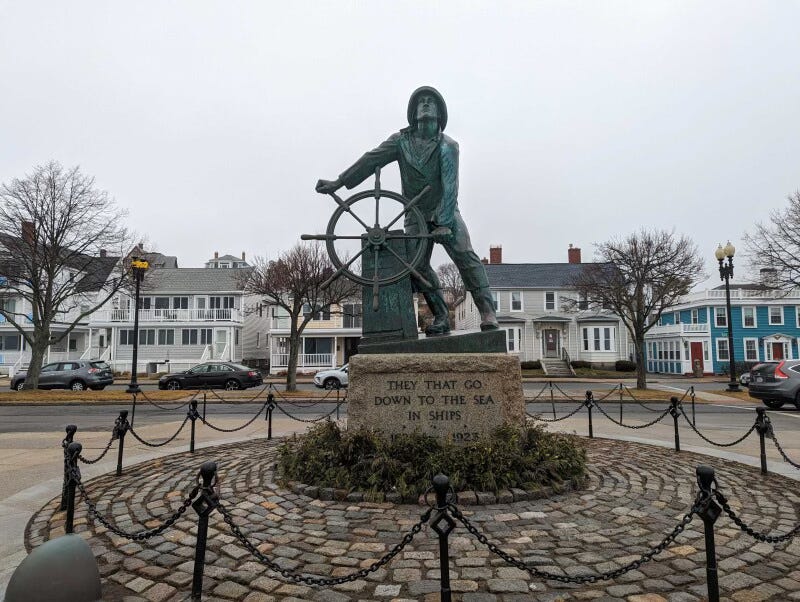
Almost 35 years ago, a long liner named the Andrea Gail out of Gloucester, Massachusetts sank in 70-foot seas without even calling a mayday. She was near the shoaling water of Sable Island – the “Graveyard of the Atlantic” – and still almost a thousand miles from home. And now another Gloucester fishing boat has been lost with all hands: Around 6:50 on the morning of January 30 of this year, a dragger named the Lily Jean was headed home from the Fippenies Bank, off the coast of Maine, when the Coast Guard received a distress signal from her emergency locator beacon.
EPIRBS, as they are known, are designed to float free of their mount and relay the identity of a vessel and her position to within a hundred yards. That way, an SOS can be issued even if the crew doesn’t have time to radio the Coast Guard themselves. A signal from an EPIRB almost guarantees that people are in the water, and Air Station Cape Cod had a rescue helicopter in the air within minutes. The EPIRB indicated that the Lily Jean had sunk 22 miles east of Gloucester, and the Coast Guard helicopter arrived on-scene in under half an hour. They found nothing but deck gear, an empty life raft and the body of the 55-year-old captain, Gus Sanfilippo, floating in the water.
As captain, Sanfilippo would probably have been driving the boat while his crew slept in the cabins - they’d spent the last three days working almost non-stop in arctic conditions. Whatever happened at 6:50 that morning, it was so sudden and catastrophic that Sanfilippo didn’t even have time to radio for help. He made it out of the wheelhouse but apparently not to the life raft, which had inflated and shot to the surface a few yards away. The air temperature was twelve degrees and the water was 39; in those conditions, a person can lose control of his limbs and drown within minutes.
Presumably trapped inside the doomed vessel were Paul Beal, age 70, and his 35-year-old son, Paul Jr. The father was taking a few last trips with his son before retiring, and they would have been bunking together when the boat sank. Local fishermen Sean Thierren, John Rousanidis, and Freeman Short were in the other cabins. And a 22-year-old NOAA fisheries observer named Jada Samitt was also on board. Samitt graduated from the University of Vermont last year and became a fisheries observer almost immediately.
When the Andrea Gail was lost thirty-five years ago, I was living on Gloucester and working as a climber for tree companies. I was also trying to turn myself into a journalist. I’d torn up my leg with the chainsaw and was still walking with a limp when a massive storm rolled into the coast. I’d never seen waves so huge, so slow, so unstoppable, and a few days later, I read that a local boat had sunk with six men off the coast of Newfoundland. Data buoys registered wave heights of almost one hundred feet during the height of the storm, and it was no mystery that the Andrea Gail had sunk; if anything, it was a mystery that the rest of the fleet hadn’t.
Gloucester went decades without a loss of that magnitude, but another tragedy was almost inevitable. The fishing industry is notoriously dangerous, and boats that have survived huge storms can sink in a dead calm if something goes wrong. Several years ago, my young nephew crewed on a lobster boat that sank without warning in light winds off the coast of Massachusetts. He fought his way into the wheelhouse to call a mayday and then dove overboard to try to catch the life raft, which had inflated automatically and was drifting away downwind. The captain later told a local paper that he and the crew had only survived because my nephew managed to catch the raft.
But why had the Lily Jean sunk? She was a rugged steel-hulled boat built to handle extreme conditions, and Sanfilippo was one of the most experienced captains in the harbor. Sometimes draggers will snag their nets and pull themselves over, but that was probably not the case because the Lily Jean had a hold full of fish and was headed home. A rogue wave is also unlikely because the wind was coming straight off the coast, which meant there was very little fetch for wave heights to build. A sudden catastrophic leak was possible, but that would have probably given Sanfilippo time to call a mayday and get his crew out of their bunks. Or maybe they’d taken a freak sea, rolled, and the pen boards in the hold had broken and released tons of frozen fish.
A final possibility was that she had iced up from sea spray hitting the rigging and become catastrophically top-heavy. According to one longtime fisherman, a common area for icing up is around twenty miles offshore, where boats encounter the colder air that sits over a land mass. The ice has to be chopped off the rigging with axes and mallets, but sometimes it builds up so suddenly that it destabilizes the boat. The word in Gloucester is that ice probably wasn’t the cause, but there wasn’t an obvious alternative. One of the problems with ships is that they just disappear. Survivors are left not only with no answers but with no one to bury.
When I was first researching the loss of the Andrea Gail for a book that I imagined on dangerous jobs, I started at the Crow’s Nest, a fisherman’s bar where the crew had spent their final night on shore. It overlooked the harbor and had a big, enclosed bar top and a pool table and photographs of the Andrea Gail and her crew on the walls. I usually stayed in one of the rooms upstairs, which was where fishermen often stayed between trips. The bartender, Ethel Shatford, was the mother of one of the crew members, and I remember very carefully taking a place at the bar and asking her if she wouldn’t mind talking about it. It took a while for the fishermen who’d clustered around me to go back to their conversations and their pool games.
To my surprise Ethel took a liking to me, and I eventually became close to her and her family. She died several years later, but I stayed in contact with her daughter, Mary Anne, who was married the bar owner, Gregg Sousa. When I heard about the loss of the Lily Jean, I immediately called them. “We’ve had losses over the years, but the Lily Jean is by far the most similar to the Andrea Gail because of the number of people,” Gregg said. “Paul Jr. lived upstairs for a while. He always paid his rent. We knew both him and his father very well. At 9:30 that morning I heard something had happened, and by 10:30 I knew everyone was dead.”
Mary Anne put me in touch with Paul Beal’s brother, Ricky, who agreed to talk to me on their recommendation. Paul and Ricky’s grandfather had moved from Maine and taken a job manning the Thatcher’s Island lighthouse, and both men had started fishing pretty much as soon as they could. Paul’s first trip on a commercial boat started the day he graduated high school; he grabbed his diploma, raced down to the harbor and was offshore on the Lady of Fatima for fourteen days. Ricky told me that his brother was the “twine man” on the Lily Jean because he was the only crew member who knew how to mend a net by hand.
After the Lily Jean was lost, Ricky’s daughter had told him that she’d lived her whole life knowing that that could happen to him as well. “The fishermen know it’s a possibility, of course,” he said. “But I never realized the kids knew it as well.”
I asked what the appeal of fishing was, and Ricky was silent for a long time. “It’s hard to explain,” he said. “We’ve all seen some beautiful, beautiful things out there. A beautiful sunrise. Baby whales with their mother. The northern lights. And it’s also the challenge of trying to catch something you can’t see.”
The Coast Guard searched for the missing crew members for 24 hours before calling it quits because their chance of survival was virtually zero. A service was held at St. Ann’s church in Gloucester the following day, and Jada Samitt’s family came to grieve with the people of Gloucester. “Jada was on the Lily Jean that day because of her strong belief in her work,” the family said in a statement. “Not only as an observer, but as someone who knew her important role as a crew member. Jada was from Virginia, but her roots ran deep here, and she loved these waters.”
Please give to a fund to help the grieving families of the Lily Jean:
https://fvlilyjeanfund.org/
Such a beautiful tribute for such a horrible loss. The only thing we can ask for is that we are doing what we love when our end comes. It’s unfortunate that there is so much danger and yet that seems to be some of the lure. May they find Peace in the seas that they loved so much.
Thanks for focusing on this calamitous loss. I grew up in Rhode Island, worked in marine fisheries in summers, getting to know lobstering and crab crews in the process. Moving to Downeast Maine four years ago, we've seen too many instances when those harvesting the bounty of the sea are lost. The list of names on the monument in Lubec continues to grow. I wrote a post, and a song, about this: https://revkin.substack.com/p/on-the-human-cost-of-harvesting-the