

The other day at the beach I saw a man at some distance kneeling in the sand, facing east. He leaned forward on his palms until his forehead was inches from the ground - the classic act of Muslim humility. He stayed prostrate for a few moments, rose back up, waited, and then went down again. He did this several times until I saw a wisp of smoke coming from the sand. The man was not praying; he was trying to get a fire going for a cook-out.
Acts of prayer may take their form from ordinary life rather than the other way around. The Christian address to God – palms open, arms upraised - is exactly how young children ask to be picked up by adults. And the classic Christian prayer, with the palms pressed together in front of the chest, originated in Asia as a simple act of respect between two people. It is virtually the only way to show that you are neither armed nor begging while also acknowledging another person. What all these prayer forms have in common is that they are a direct communication between the individual and god. They do not require a priest or shaman to make the connection, and they certainly don’t permit the monetizing of salvation. The idea that you cannot save your soul without going through a priest - and paying for his trouble - was a relatively recent scam in human history. For thousands of years, what happened between you and God was your own affair.
The Christian church changed all that. In this new upside-down world, communicating directly with God was not an act of faith but of heresy. The word comes from the Ancient Greek for “choice,” which was clearly not something that the medieval clergy wanted people to have. Heresy was a capital crime, and the state regularly put people to death for rejecting church doctrine. There was no daylight between the authority of the state and the authority of the church; they were one in the same, and almost no one dared say otherwise,.
That changed in the early 1600s, when a Christian sect called the Quakers began to protest church authority. The Quakers refused military service, rejected the idea of original sin, declared there to be no difference between clergy and laity and believed in something called “inward light” - the idea that God is inside all of us. For the Church of England and its offshoots, like the Puritans, the loss of revenue represented by this kind of do-it-yourself religion was too much to abide. Inward light was declared heretical, and the penalty was death. The Quakers fled to the New World but quickly ran afoul of Governor John Endicott, who ran the Massachusetts Bay Colony with a humorless brutality. (Unfortunately, there is still a college named after this man.) If you spouted your Quaker nonsense on the streets of Boston, you would be flogged, sentenced to forced labor and then exiled to Rhode Island - a sanctuary of free thought. If you returned and did it again, your ears would be cut off. The third time, your tongue would be bored out with a red-hot iron. Finally, you would be hung on Boston Common.
But Endicott did not anticipate the courage and principle of ordinary people. A Quaker woman named Mary Dyer kept returning to Boston to preach, knowing that the state legislature was loathe to oversee the torture and execution of a woman. But she was determined to get Endicott to either execute her or nullify the law, and on October 27, 1659, Dyer was led to the gallows and ordered to recant her heresy. She replied, “No eye can see, no ear can hear, no tongue can speak, no heart can understand the sweet incomes of the spirit of the Lord that I now enjoy.” Captain John Webb declared her to be “guilty of her own blood” - meaning it was her fault that she was going to die - and she replied that she was trying to protect him from being guilty of her blood. “And so she was swung off,” as historian Horatio Rogers put it. But within months, the Massachusetts legislature de-criminalized heresy and established freedom of speech on these shores.
Europe was considerably slower to drop its barbarism. The last execution for heresy was almost exactly two hundred years ago in Valencia, Spain, when a man named Cayetano Ripoll was convicted of insisting that you did not have to go to Mass to save your soul. You could appeal directly to God instead. The religious courts sentenced Ripoll to be burned alive, but the state intervened and ruled that they would have him hung instead, and on July 26, 1826, Ripoll was swung off into eternity. At that point the steam engine had been invented, Pierre-Simon Laplace had published his famous treatise on planetary gravitation, and chemists had isolated benzene and aluminum and discovered the atomic structures within isomers. Because of people like Dyer and Ripoll, Europe’s most brilliant minds were able to make staggering advances in science, medicine, and technology while former scientific pioneers like the Arab dynasties of North Africa and the Levant languished in the darkness of religious certainty. The great and terrible wealth the West now enjoys is the direct result of people like Dyer and Ripoll, who died so that other people could think and worship in whatever manner they saw fit.
I am not a religious man, but all I have to say is, Thank God for the brave amongst us.
“Ripoll was swung off into eternity.” Never used swinging as a euphemism for hanging but it does sound nicer.
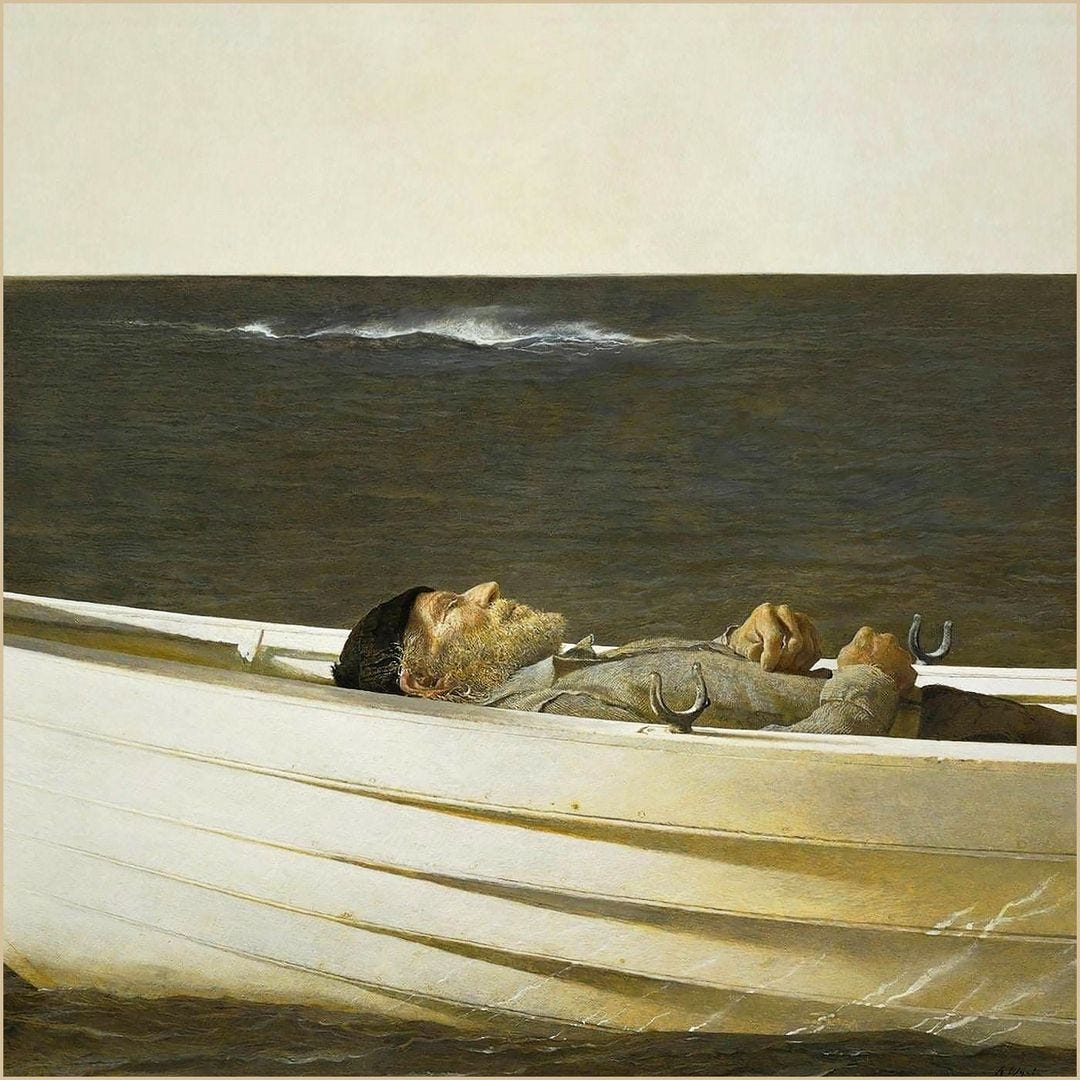
Who is this artist, the painting is haunting....
I never really knew there was a history to how we pray...and people died for this...and still do.