

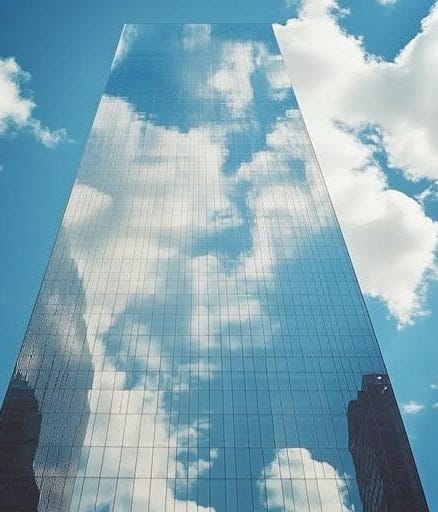
Sometimes in New York you find yourself walking down the street with two shadows to your name, one lit by the natural sun and another by its unholy twin reflected off the pyrolitic glass of a skyscraper. The micro-coating of treated glass is so efficient that if buildings are even slightly concave, the focus of their reflections can melt certain car parts and singe human hair. Your shadow is the exact shape of the solar energy blocked by your body and in a sense is the hole that you leave in the universe. Nature did not intend for you to leave two holes in the universe and, until recently, you could not have - until the Pilkington Brothers came along with their pyrolitic glass.
Likewise, you are also not supposed to have two independent lives and yet - with social media - it can seem that you do. You now cast two shadows, as it were: One created by your actual life and another by your online presence. The average person consumes around 100 billion bytes of information per month, considerably more than the number of nerve cells in their brain. It’s just binary data in the pixels of a computer screen, but focused right - like the reflective windows of a concave building - that much data can both destroy or supercharge a human life. For many people, their online existence rivals the importance of their biological one. For many people, this new sun is the one actually illuminating the world they live in, and their second shadow is the one that represents who they truly are.
Whether this is a net loss or gain for the human race remains to be seen, though the rampant mental health issues of affluent society do beg the question of what we are doing wrong. Western societies have some of the highest rates of depression, anxiety, suicide and addiction in history. Regardless, this alternate existence is so real and powerful that it’s clearly here to stay, regardless of it’s effects. The problem is that the secondary life arises not as a product of the natural world, but as a product of human genius. We owe our existence, as mammals, to the nearest star and the life processes that its heat enables, but we owe our secondary life to the interventions of a tiny group of now exceedingly wealthy men. These men effectively fill the role of gods: They create the reality that the rest of us inhabit.
And they can turn it off whenever they want.
It’s no ordinary businessman that can do this; that’s a creator and a destroyer of worlds. Humans have gone through many eras where men - yes, it’s almost always is men - appear to have such power. For roughly 200,000 years, humans lived in relatively egalitarian groups that were hard to tyrannize because freedom from an abusive leader was simply a matter of slipping away in the middle of the night. As well, there is evidence that the most common capital offense in these societies was exploiting one’s own people; cave paintings from mesolithic Spain depict a group of armed men standing around a corpse bristling with arrows. In all likelihood, the dead man was a leader who was killed by a group that did not appreciate being bullied. Even among chimpanzees, coalitions of males - and occasionally females - will gang up on a domineering alpha that has worn out his welcome.
But with the invention of agriculture around ten thousand years ago, leaders could stockpile enough food to pay a standing army that could easily put down its own citizenry. One of the first cities, Uruk, had 40,000 people within its great walls but was nevertheless subjugated by a professional army that served a man who was thought to be partly divine. And farmers must spend years clearing fields and building irrigation systems; abandoning that kind of investment is very different from heading into the mountains with a bow and arrow or a flock of sheep.
The miracle of modern democracy was that it returned agricultural society - and, later, industrial society - into a system where rulers were once again bound by the same laws as everyone else. Democracy takes the decency and fairness that are so instinctive for people in a small group and codifies them to apply to nations of hundreds of millions of people. No matter how popular or abusive a democratic leader may be, he simply can’t exempt himself from the rule of law or the outcome of elections. Many try, of course, but it’s impressive how transient - one could even say “doomed” - these power grabs are. Of the fascist regimes of Europe, only Franco died in power as an old man, and Spain reverted to a democracy immediately afterwards.
But the “second sun” of the Internet seems to have reverted us to an era of alpha male dominance. Tech and software companies control so much wealth that they are close to escaping the bounds of international law, and their creators - men like Musk and Thiel and Zuckerberg - now sway elections and influence policy around the world. With the flip of a switch on October 14, Elon Musk reduced Ukraine’s Starlink capacity and crippled their air defenses. Within hours, Russian missiles and drones slammed into Ukrainian cities unimpeded. U.S. courts have inflicted small wounds on these men, but their power relationship with society as a whole is increasingly simian. When a chimpanzee wants to avoid being pummeled or killed by an angry alpha, he makes himself small, avoids eye contact and exposes his rump and genitalia. Those humiliations are a fair approximation of how our politicians and institutions now relate to men like Musk and Thiel.
The reason for this voluntary subservience is that our political parties exist in a virtual state of war with each other - a war largely enabled by the Internet - and many leaders are more focused on defeating their rivals than protecting constituents from harm. And defeating rivals is vastly easier with someone like Musk - who donated almost $200 million to the Republican Senate campaign in Texas. That means that any path out of this problem must be one with no political ideology. Climate change is a liberal issue; immigration is a conservative one. Even school shootings are quickly turned into partisan tank traps that stop anyone from crossing the lines. There has not been a single national issue that transcended partisan loyalty and united both sides - until now. Finally, the nation has something that algorithms can’t fracture and politicians can’t pervert: Data Centers. Popular opposition to these monstrosities cuts across every political identity. Almost three quarters of Americans are opposed to building a data center in their community. Even the Vietnam war at the height of the peace movement was more popular than data centers are now.
Ironically, it may be bipartisan opposition to data centers that saves this country from itself. In that case, we have Elon Musk and his weird crew to thank. Imagine if a truly populist movement against data centers took down both political parties? Imagine if the second shadow of our our online existence grew to require so much data that we the people finally rose up? The courts have failed us, Congress has abandoned us and political leaders have sold us out, but opposition to data centers may be the ultimate way to stop the new alpha male elite.
How appropriate. How wonderful. How chimpanzee.
Sebastian, fascinating piece. The opening about reflection and the image of two shadows had me hooked. But what really stayed with me was where you took it: who we are as a people and what happens to our societal norms when so much of our life moves into a world controlled and manipulated by a handful of powerful men.
This certainly isn’t the first time America’s faced that problem. We’ve had instances where we pushed back—Teddy Roosevelt and Hiram Johnson, for example. But what worries me now is the challenge of making that course correction when the people who hold so much of the power don’t just hold power over economics and politicians, but over information. Over what is “true.”
We’re often not arguing over values or ideology but about two competing sets of “facts” about an issue that are impossibly incongruent with one another. That is the reality of social media and the internet age, plus the erosion of trust in the media (often well deserved).
And as people get isolated online, we lose the natural check on being an asshole. When I was a kid, if you were an asshole the other kids wouldn’t let you play with them. That made you follow the rules. On social media, the opposite happens. Not only can you be outrageous anonymously, but the algorithms reward outrage and extremists. The addictive nature of their product and the direction of the algorithm have weaponized our own psychology against us.
So I hope you’re right about data centers. I hope opposition signifies something that transcends politics and perhaps a moment where we seek to regain some measure of control over our lives. I also hope we seek to return to just a bit more honesty in our debates.
And this is really wild, but maybe we start talking about things in person. Heaven forbid we sit around a dinner table, on a tailgate or a porch, and talk about these things as humans. Passionately disagree without asking someone to leave or refusing to invite them back.
And maybe we’re willing to, if not have our mind changed, at least have our mind informed about the sincerity of the belief of someone on the other side.
That would really be something.
Yes! I am behind the anti-data center protests! And yes, how apropos for this one crazy thing to bind us together ....we need to not let thiel and musk ruin our lives.